
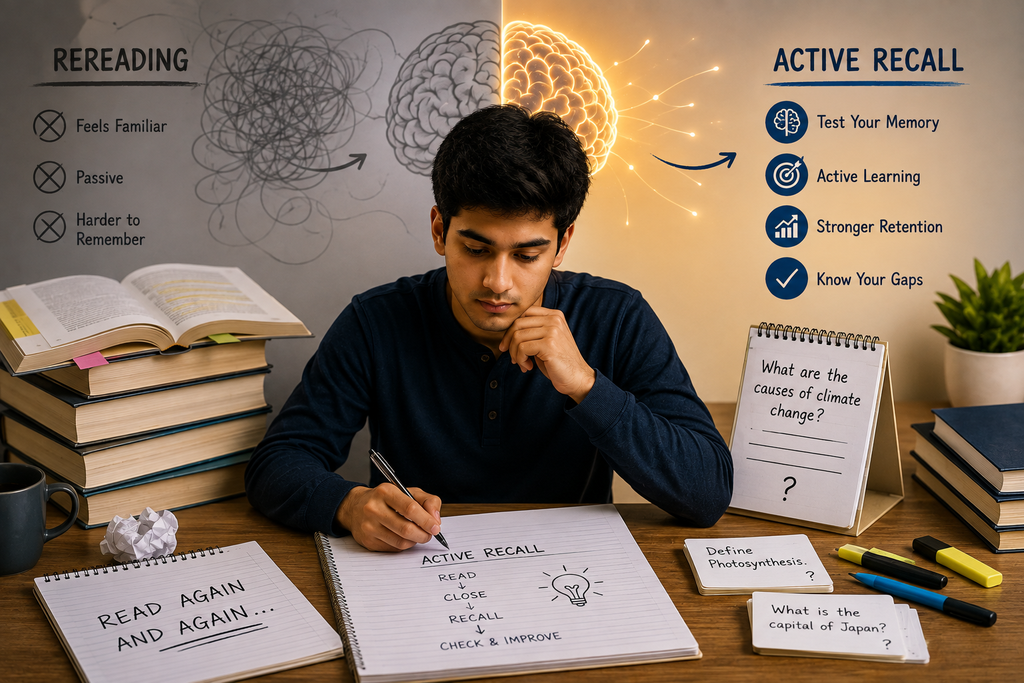
Studying requires more than reading information. Your brain needs practice to remember information. Many students simply reread their notes. This feels easy and familiar during studying. However, familiarity does not ensure strong memory. Active recall uses a different learning process. It asks students to retrieve information themselves. This process can strengthen memory over time. Both methods have different learning effects.
Rereading can make information feel familiar. That feeling can sometimes create false confidence. You may recognize words without remembering them. Active recall tests what you truly remember. It also shows which areas need improvement. This makes studying more focused and useful. Students can identify their weak topics quickly. They can then spend more time practicing. This approach makes learning more active.
Choosing the right method can improve studying. Students often need simple learning strategies. Active recall offers an effective study approach. Rereading still has some useful purposes. Both methods can work in different situations. Understanding their differences helps students choose wisely. Good studying depends on active mental effort. Better methods can also save valuable time.
What Is Active Recall?
Active recall is the process of pulling information back from memory. You do this without checking your notes. For example, ask yourself study questions. Then answer them without looking. This forces your brain to retrieve information. Retrieval strengthens memory through repeated practice. It also shows what you actually understand. This makes active recall highly useful.
You can practice active recall easily. Close your textbook after reading a section. Then explain the topic from memory. You can also write important points down. Flashcards provide another useful recall method. Practice questions can test your understanding. Teaching someone can also support active recall. These methods require effort from your brain.

What Is Rereading?
Rereading is reading over the same material more than once. Textbooks and notes are read repeatedly by students. It is comfortable because the information is familiar. You are familiar with the words and phrases. This makes it easier to think that it’s easier to study. But it’s not necessarily the easiest way to study; that’s the effective way to study. Rereading might offer some memory practice.
Rereading can have some positive functions. It can present new information at the beginning. It can revise concepts that were remembered before practice. It can also be beneficial when it comes to understanding unclear or confusing concepts. But rereading should not be the only way. It is more effective to do both rereading and recall.
How Does Active Recall Work?
Active recall requires your brain to retrieve information. Retrieval creates stronger memory connections over time. Every successful attempt reinforces important information. Difficult attempts can also support learning. Mistakes show where your knowledge needs improvement. You can then review those weak areas. This creates a more focused study process.
Active recall works through repeated retrieval practice. Suppose you study ten biology terms. Close your notes after studying them. Try writing all ten terms. Then check your answers against your notes. Repeat the process later. Each session challenges your memory again. Gradually, recalling information becomes easier.
How Does Rereading Work?
Rereading gives your brain repeated exposure. You see the same information multiple times. This can improve familiarity with important material. However, familiarity differs from actual recall. You may recognize an answer without producing it. Exams often require producing answers independently. Therefore, recognition alone may not suffice.
Rereading can help during initial learning stages. It can introduce difficult concepts before testing. It can also refresh important definitions quickly. However, repeated rereading may become passive. Passive studying often requires less mental effort. Less effort can create weaker retrieval practice. Using recall afterwards makes studying stronger.
Active Recall vs. Rereading
Active recall requires active mental participation. Rereading usually requires less mental effort. Active recall tests your actual memory. Rereading mainly provides repeated exposure. These differences affect how information becomes remembered. Active recall also reveals knowledge gaps. Rereading may hide those gaps temporarily.
Students can combine both methods effectively. Start by reading unfamiliar study material. Focus on understanding the main ideas. Then close your notes completely. Ask yourself questions about those ideas. Answer everything you remember without checking. Review mistakes and repeat the process. This combination creates balanced study sessions.
Benefits Of Active Recall
Active recall can improve long-term memory. It encourages repeated information retrieval. This makes knowledge easier to access later. It also helps identify weak areas. Students can focus on difficult information afterward. This saves time during future study sessions. Active recall can also increase exam confidence.
Another benefit involves better understanding. Questions require students to process information. They cannot simply recognize familiar sentences. They must explain concepts using their memory. This can reveal misunderstandings more clearly. Regular practice can improve independent thinking. It can also prepare students for exams.
Benefits Of Rereading
Rereading provides quick exposure to information. It can help students understand unfamiliar material. Complex topics may require several reading sessions. Rereading can make difficult ideas more familiar. It can also refresh previously learned information. This makes rereading useful for review purposes. However, it should support stronger methods.
Rereading works best when used strategically. Read the material carefully during initial learning. Highlight only the most important information. Avoid reading the same pages endlessly. Follow reading with questions or practice. This changes passive reading into active learning. The combination can improve overall study quality.
Which Method Builds Better Memory?
Active recall generally provides stronger memory practice. It requires information retrieval without immediate help. This process strengthens access to stored knowledge. Rereading provides less retrieval practice. It mostly exposes students to familiar information. Therefore, active recall offers greater memory challenges. Those challenges can support stronger learning.
However, memory depends on several factors. Sleep can affect learning and memory. Regular practice also supports better retention. Understanding concepts remains extremely important. Active recall cannot replace basic understanding. Students should first understand important concepts. Then they should practice retrieving those concepts.
Which Method Saves More Study Time?
Active recall is a strategy to help maximize study time. Emphasizes content that is difficult to comprehend. It’s easy; topics don’t need to be repeated. Students can easily spot their weak spots. This helps to avoid duplication of data. May take longer overall to reread. Students will be able to review and relearn information they have previously learned.
Learning is efficient when it is done deliberately. Have a learning goal in mind. Attempt to concentrate on one small part at a time. Test ASAP afterward. Write down the questions that you had wrongly. Look for the items listed. Re-test yourself again at a later date. This can aid in saving study time.
How Can Students Use Active Recall?
Students can use flashcards for active recall. Write questions on one side. Put answers on the opposite side. Test yourself before checking answers. You can also create practice questions. Answer them without using your notes. Then check your responses afterward. Repeat difficult questions during later sessions.
Another useful method involves teaching others. Choose a topic you recently studied. Explain it without checking your notes. Use simple words during your explanation. Notice where your explanation becomes difficult. Those areas probably need more review. Return to your notes afterward. Then explain the topic again.
Common Mistakes Students Make
- Depending entirely on rereading.
- Spending hours reviewing the same pages.
- Confusing familiarity with real understanding.
- Struggling to remember information without notes.
- Avoiding difficult practice questions.
- Checking answers too quickly.
- Missing valuable retrieval practice.
- Studying only when exams approach.
- Creating stressful, rushed study sessions.
- Avoiding regular study sessions.
- Failing to review material over time.
- Not testing themselves regularly.
- Ignoring consistent recall practice.
- Focusing on short-term learning only.
Conclusion
Active recall and rereading serve different purposes. Rereading helps students understand new study material. It can also refresh previously learned information. However, rereading alone can feel misleading. Students may recognize information without remembering it. Active recall gives students a stronger memory check. It requires them to remember information independently. This process also highlights areas needing improvement. Students can then focus on difficult topics. Both methods can work well together. Students should first read their study material.
They should understand the main ideas carefully. Afterward, they should close their notes. Then, they can test themselves using questions. Flashcards can also make recall practice easier. Mistakes should be reviewed without feeling discouraged. Difficult topics should receive additional attention. Students should repeat this process regularly. Studying across several days improves retention. It also reduces last-minute exam pressure. A balanced approach makes studying more productive. Therefore, students should combine both methods wisely.
FAQs
How to do active recall?
Use flashcards, questions, and practice tests. It’s also possible to speak on a subject. Another helpful way of recalling is teaching others
Does active recall save study time?
Using active recall may help you focus your studies. Quickly finds your weak points. This decreases the unnecessary review of known topics.
Should students give up on rereading altogether?
But no, it’s not all bad to go back and read again. Use it as a tool for preliminary comprehension. Then move on to active recall.
How often should I do active recall?
Repeat the learning for multiple study sessions. Reread challenging material several times. Spaced practice can assist with improved retention.
Why is active recall important?
Active recall is the act of remembering information. Answers questions without using notes. This way, memory is reinforced by repeated practice.